
The Niche Skin Scent Journal · Part V
WHAT “NATURAL” REALLY MEANS IN MODERN PERFUMERY
Natural does not mean simple, untouched or automatically safer. In modern perfumery, the word only becomes useful when we ask what was grown, how it was transformed and what it cost to produce.

Natural is one of perfumery’s most persuasive words. It is also one of its least precise.
It can suggest purity, rarity, tradition and closeness to the earth. It can also become a shortcut: natural equals good; synthetic equals inferior. That opposition may be emotionally satisfying, but it does not describe how fine fragrance is actually made.
A rose absolute is not a rose placed inside a bottle. A bergamot oil is not the intact fruit. An iris butter may represent years of cultivation and drying before a single aromatic material is obtained. Modern perfumery begins when nature is observed, harvested, separated, concentrated, stabilised and composed.
Natural does not mean untouched
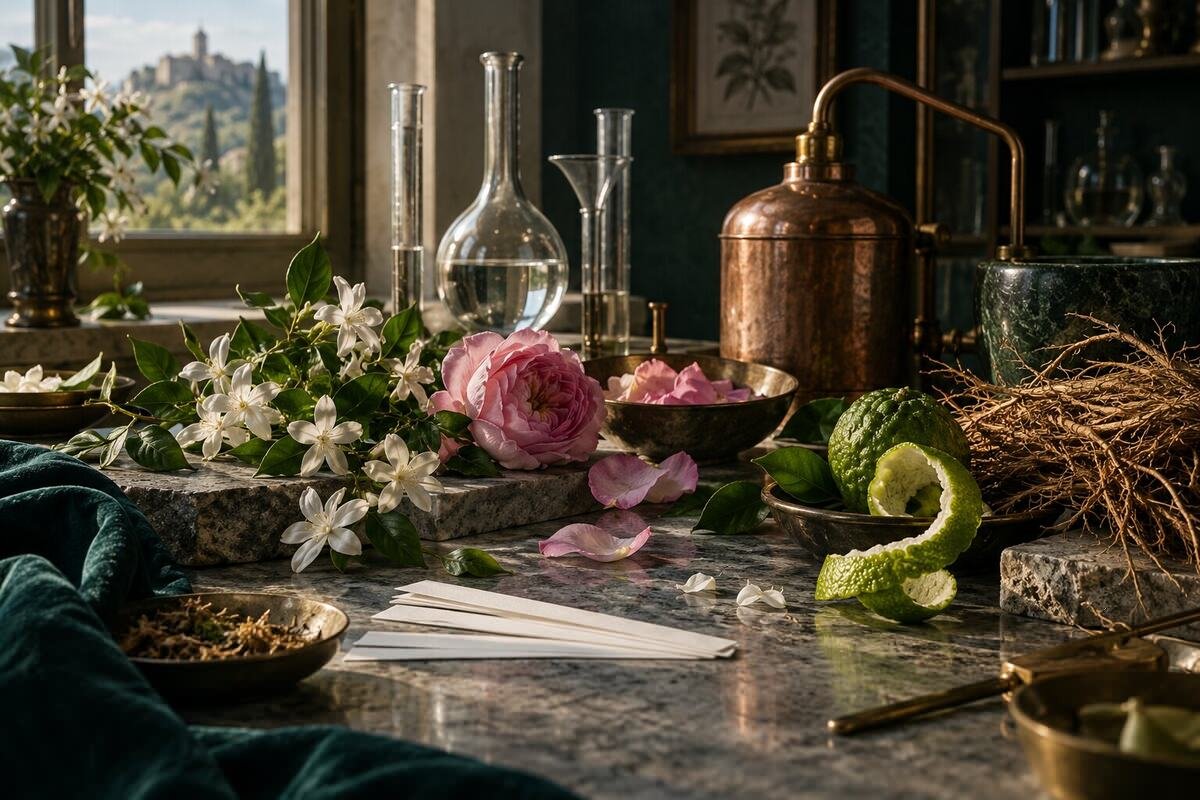
Every natural perfumery material is the result of a process. Steam distillation separates volatile aromatic molecules from plant matter. Expression mechanically releases oils from citrus peel. Solvent extraction can produce a waxy concrete, which is then refined with alcohol into an absolute. Carbon-dioxide extraction uses pressure to obtain a different aromatic profile. Tincturing slowly draws soluble components into alcohol.
Each method makes choices on behalf of the flower, wood, resin or fruit. It captures some molecules more readily than others. Temperature, pressure, solvent, time and storage all shape the result. Extraction is therefore not a neutral doorway between field and formula. It is the first act of interpretation.
Nature supplies the material. Technique decides which version of it reaches the perfumer.

The same plant is never simply the same material
Natural materials are complex mixtures rather than single, fixed substances. Their composition can change with geography, climate, soil, harvest date, plant variety, plant part and extraction method. Jasmine grown in one region, picked at one hour and extracted under one set of conditions is not chemically or sensorially identical to every other jasmine.
This variation is part of the beauty of naturals, but it is also a technical responsibility. Perfumers and suppliers evaluate batches for odour, purity, stability and safety. They may blend lots to achieve consistency or reserve a distinctive harvest for a formula that benefits from its character.
The International Fragrance Association treats essential oils, extracts and similar materials as Natural Complex Substances. Its nomenclature guidance reflects the importance of botanical source, plant part and processing method. “Lavender” alone is not a complete technical description.
“Natural origin” is a framework, not a mood
In cosmetics, ISO 16128 offers technical definitions and criteria for natural and organic ingredients, derivatives and product calculations. This is useful because it replaces vague atmosphere with a method: what is the source of an ingredient, what transformations has it undergone and how should its natural-origin contribution be assessed?
But a percentage cannot tell the whole story of a perfume. It does not describe the quality of a harvest, the skill of a distiller, the traceability of a supply chain or the beauty of a formula. Nor does the word natural, by itself, answer questions about safety, environmental impact or labour.
A responsible brand should therefore use the term with context. Which materials are natural? From where? Extracted how? Supported by what documentation? Precision is more luxurious than suggestion.
Natural does not automatically mean safer
Plants make powerful chemistry. That is one reason they smell extraordinary. Natural materials may contain constituents such as limonene, linalool, eugenol or citral, all of which can require careful handling and, depending on the finished product, allergen disclosure.
The IFRA Standards may prohibit, restrict or set purity requirements for fragrance ingredients. Those limits also matter when a restricted constituent occurs inside an essential oil or another Natural Complex Substance. Safety assessment does not stop because an ingredient came from a flower.
This does not make naturals undesirable. It makes expertise necessary. Dose, exposure, product type, composition and the complete formula matter more than a comforting adjective.
Natural does not automatically mean sustainable
A natural material can support biodiversity, traditional knowledge, rural employment and regenerative agriculture. It can also demand extensive land, water, energy and transport; depend on a low-yield crop; expose a vulnerable species to pressure; or hide labour that is poorly paid and difficult to trace.
There is no honest sustainability verdict based on origin alone. The right questions are specific: Is the plant renewable? What is the extraction yield? Are agricultural inputs managed? Is the source traceable? Are workers protected? What happens to the biomass after extraction? Can the supply remain stable without damaging an ecosystem?
Sometimes a carefully sourced natural is the responsible choice. Sometimes a biotechnology-derived or synthetic alternative reduces pressure on land or a threatened resource. Often the best answer is a considered combination.

What synthetics make possible
Synthetic molecules are not merely cheap imitations of nature. Some isolate a facet that exists in a natural material; others create an olfactory effect with no direct botanical equivalent. They can provide radiance, diffusion, abstraction, stability and consistency. They can also help a perfumer use a precious natural material more intelligently rather than asking it to carry the entire structure.
Think of jasmine. A natural absolute can bring depth, warmth and living complexity. Carefully chosen aroma molecules can amplify its luminosity, soften its indolic weight, extend its trail or create the sensation of petals in air. The result is not necessarily less authentic. It is composition.
Synthetics still require assessment. Their value does not come from being laboratory-made any more than a natural’s value comes from being field-grown. The material must earn its place through beauty, performance, safety and context.
The modern formula is a dialogue
The finest perfumes rarely ask us to choose a side. Naturals offer variation, texture and the emotional density of living materials. Synthetics offer precision, architecture and effects that nature alone cannot reliably provide. The perfumer composes the tension between them.
That is why a perfume should be judged on more than a percentage or a label. Smell it on skin. Notice its movement, proportion and character. Ask whether the sourcing is transparent, whether the formula is responsibly assessed and whether the finished fragrance has something meaningful to say.
Natural is not a guarantee of quality. Synthetic is not evidence of compromise. Quality is the intelligence with which materials are chosen and transformed.
The Niche Skin Scent verdict
“Natural” is not the end of the question. It is where serious questions begin.
This closes the Journal’s five-part opening chapter: from the myths that shaped French perfume history to the materials that shape modern fragrance itself.
From knowledge to skin
Discover materials through the finished fragrance
A formula becomes meaningful on skin. Explore our personally curated niche perfumes or begin with a travel-size discovery before choosing a full bottle.
Niche Skin Scent Boutique · Unit 3 · Leixlip Shopping Mall