
Niche Skin Scent Original · Perfume History
The elegant legend of Catherine de’ Medici, René le Florentin and the poisoned gloves — and what the surviving evidence actually allows us to say.
Perfume history repeats one particularly romantic story.
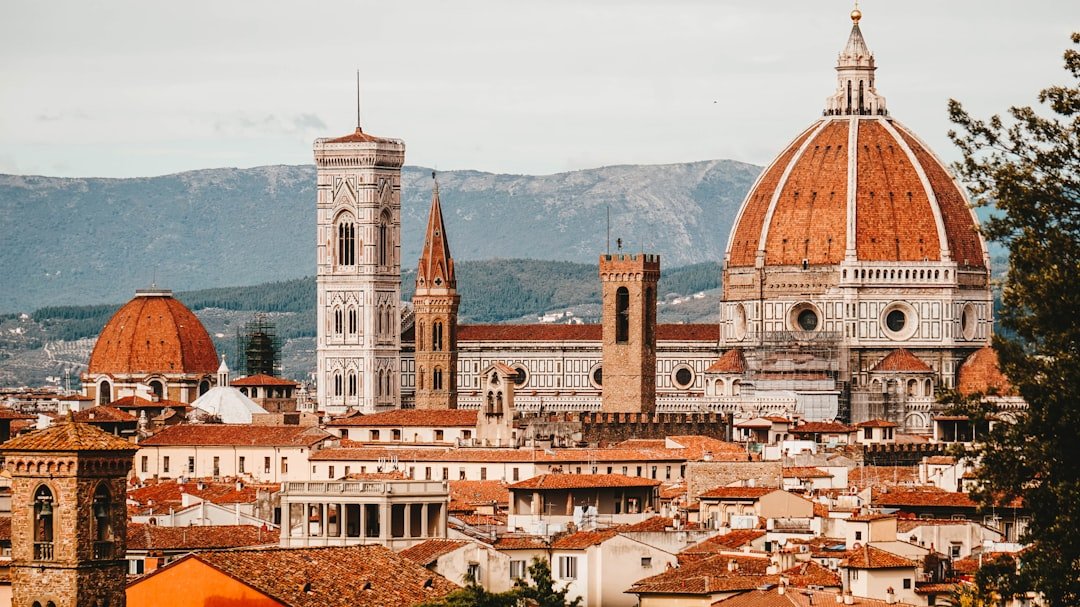
In 1533, fourteen-year-old Catherine de’ Medici travels from Florence to France to marry the future King Henry II. With her, we are told, comes her personal perfumer, Renato Bianco — later celebrated in France as René le Florentin.
He creates exclusive fragrances for Catherine, establishes a secret laboratory, teaches the French the art of perfumery and helps transform France into the world capital of scent.
A beautiful story.
But is it true?
The problem begins with the name
Sixteenth-century sources do appear to mention a royal perfumer known as maistre René — Master René. This suggests that a perfumer by that name probably existed and worked within the orbit of the French court.
But the documentary trail becomes much thinner when modern biographies become more specific.
Reliable contemporary records clearly proving that his birth name was Renato Bianco, René Bianchi or René le Florentin are remarkably difficult to find. Even his origins are uncertain: later writers variously describe him as Florentine or Milanese.
Most importantly, there is no firm evidence that he travelled to France with Catherine in 1533.
The dates do not agree
Some accounts place René in Catherine’s service only from 1547 — fourteen years after her wedding. That was the year Henry II became king and Catherine became Queen of France.
If that date is correct, one of the legend’s most memorable scenes — the young Florentine bride arriving with her faithful perfumer beside her — loses its historical foundation.
The discrepancy does not prove that René never knew Catherine earlier. It does, however, show why the story should not be repeated as settled fact.

France already had a fragrance culture
The larger claim — that Catherine and her perfumer “brought the art of perfumery to France” — is even more difficult to defend.
Long before Catherine’s arrival, people in France were already using scented waters, aromatic oils, incense, pomanders, medicinal distillates and fragranced preparations. The country was not an empty stage waiting for Italian perfume knowledge to appear.
Catherine did not introduce perfume to a land without scent.
That does not mean her influence should be dismissed. She may have helped intensify the fashion for Italian luxury, aromatic accessories and, especially, perfumed gloves among the French aristocracy. This is a more precise — and more historically credible — description of her role.
She did not invent French perfumery. She may have helped change its fashion, prestige and courtly language.
Why did René’s story become so famous?
Not because his perfume formulas survived.
He became famous because of poison.
When Jeanne d’Albret, Queen of Navarre, died unexpectedly in 1572, a rumour spread that she had been poisoned by the royal perfumer, maistre René, who had supposedly sold her a pair of gloves treated with a deadly substance disguised by fragrance.
The poisoning was never proved. Contemporary medical opinion associated her death with illness rather than a perfumer’s crime.
But a queen, a mysterious Italian perfumer, a luxurious shop and death hidden inside scented gloves formed a story far too powerful to disappear.
A painting is not eyewitness evidence
Nineteenth-century writers and artists gradually transformed the rumour into something that looked almost like established history.
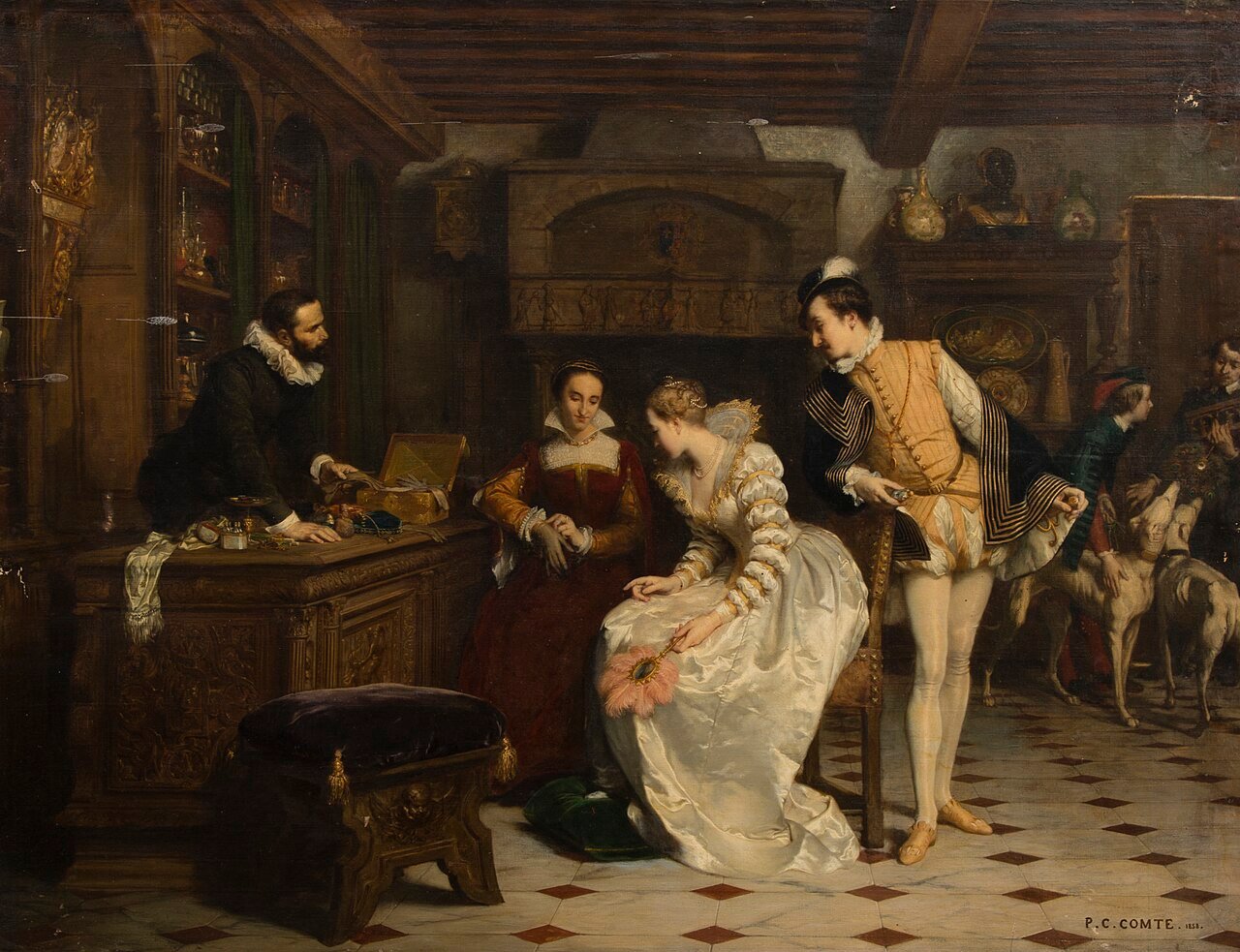
The painting shown above is not a Renaissance document. Pierre-Charles Comte created it between 1852 and 1858 — almost three centuries after the events it depicts. In the scene, Jeanne d’Albret is shown buying the fatal gloves from René.
The image does not prove that the crime happened.
It shows us what a legend looks like once it has been given a convincing face.
The verdict
A perfumer known as Master René probably existed.
But the full Renato Bianco biography — his journey with Catherine in 1533, the secret laboratory, the authorship of Acqua della Regina, and the claim that he brought perfumery to France — is not documented with the certainty often suggested by modern perfume histories.
That distinction matters. Perfume history deserves wonder, but it also deserves precision.
The final note
Sometimes perfume history smells not only of bergamot, rose or amber.
Sometimes it smells very strongly of marketing.
Next in the Journal: what Catherine de’ Medici may genuinely have changed in French fragrance culture — and what later writers attributed to her without sufficient evidence. →
Niche Skin Scent
Selected. Not advertised.
Editorial note: This article distinguishes documented evidence from later retellings. Where the surviving record is uncertain, the wording deliberately remains cautious.
From history to skin
Continue the story on your skin
Perfume history becomes meaningful when you experience fragrance on your own skin. Discover our personally curated niche perfumes or begin with a travel-size discovery.
Niche Skin Scent Boutique · Unit 3 · Leixlip Shopping Mall